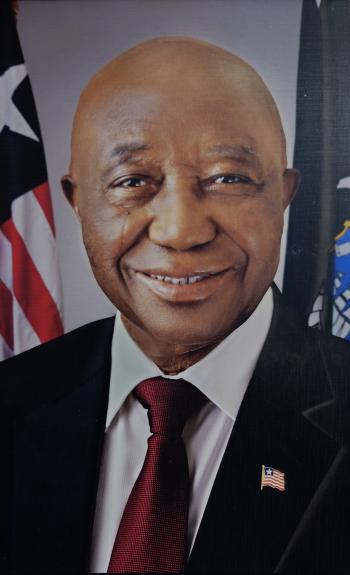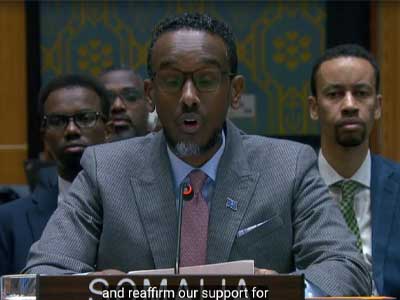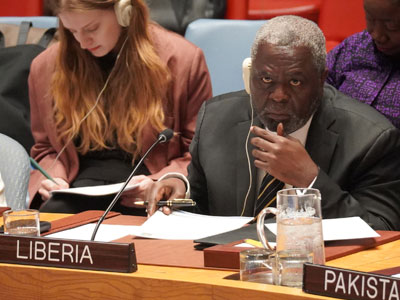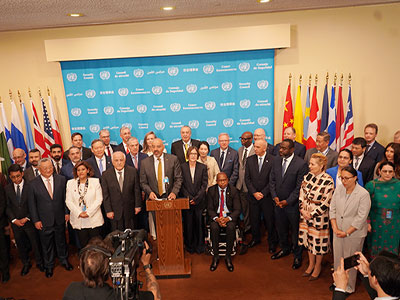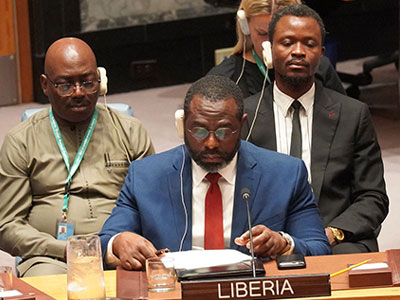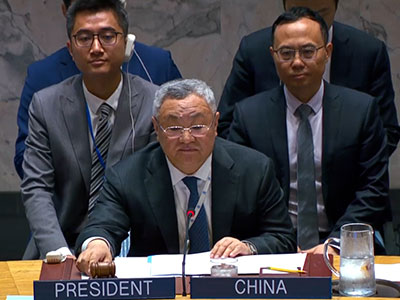
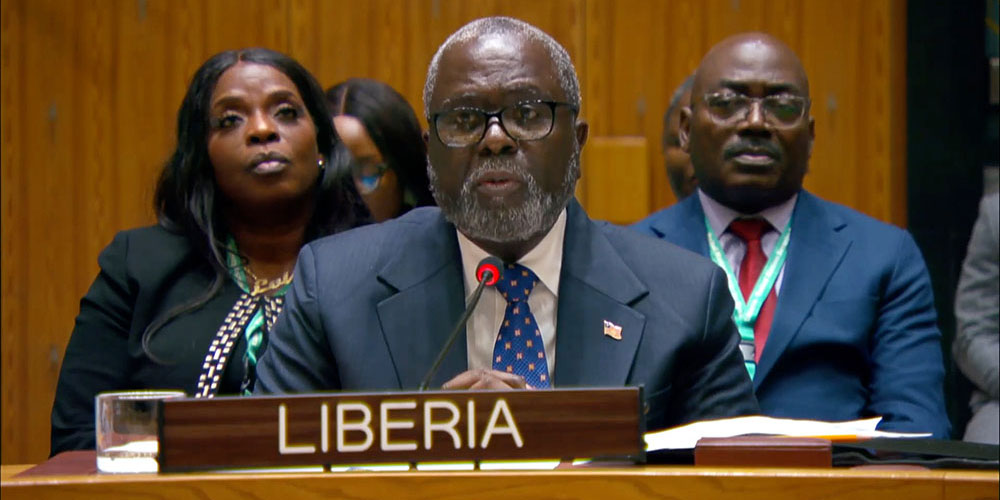
Delivered by H.E. Amb. Lewis Brown II, Permanent Representative of Liberia to the United Nations, on Monday, March 2, 2026 at the 10,113th meeting of the Council, which was chaired by Mrs. Melania Trump, First Lady of the United States of America
Liberia thanks you, Madam first lady, for bringing your important voice and distinguished office to the issues of children in conflict and their much needed access to education and Technology. We also thank the United Kingdom for its effective stewardship of the Security Council during the month of February and USG Decalo for her instructive briefing. We warmly welcome the United States as it assumes the Presidency for March and thank the United States delegation for convening this timely meeting.
In today's world, the intersection of children, technology and education defines not only individual futures, but, as rightly noted by you, Madam President, the trajectory of peace itself. In conflict settings, when classrooms fall silent and connectivity is severed, the loss is not only educational, it is generational. Efforts that restore learning, expand safe digital access and protect children from technological exploitation are therefore investments in stability and human dignity.
Madam President, Excellencies, today Liberia will speak from a past that taught us what conflict steals and what education restores. We remember all too well what it means to be the child the world sought to protect. The classroom without a roof, the generation told to wait for peace before being allowed to learn. Fourteen years of civil conflict destroyed our school, dispersed our teachers and recruited children before they were literate. From all of these, we learned a painful truth. When education collapses during conflict, the conflict does not end, it simply mutates. This is why Liberia approaches today's discussion not as a development debate, but as a matter of international security. Around the world, more than 224 million children living in crisis settings are currently out of school, according to global education partners. Many before me have quoted even grimmer statistics. This is not just an educational emergency, therefore. It is a security emergency, a protection emergency and a generational emergency.
A child denied learning in a conflict zone, is exposed not only to illiteracy, but to recruitment, manipulation and exploitation disguised as survival. Similarly, a community deprived of education does not simply lose opportunity, it actually inherits instability.
In this context, digital education is simply not a luxury, it is actually a stabilizer. It is prevention policy. Across West Africa, post conflict recovery has shown us that the path from ceasefire to resilience, actually runs through the classroom.
Within ecowas, we have seen that rebuilding infrastructure alone is insufficient. Rebuilding human capital is what prevents relapses into conflict. Increasingly, this rebuilding must be digital. Africa is not waiting to be transformed by technology. We are trying to reshape technology under difficult constraints. We are developing low bandwidth platforms, solar powered systems and community driven learning models precisely because our circumstances demand innovation that is efficient, resilient and inclusive. In my home country, Liberia, when national emergencies halted schooling, community radio delivered lessons across counties, while solar powered learning centers reached communities far beyond the grid. Children shared devices, but more importantly, they shared knowledge. Our innovations did not emerge from abundance, they emerged from determination.
From these experiences, Liberia offers three proposals:
First, the establishment of a post conflict education digital recovery window within existing international financing mechanisms. Digital learning infrastructure, including connectivity devices, teacher training and child protection safeguards must be embedded in early recovery frameworks and not treated as a secondary priority.
Second, we are developing a pallet network of solar powered community digital learning hubs. These hubs function independently of unstable grades, deliver offline capable curriculum, provide teacher training modules and offer safe digital access points for displaced and conflict affected children. They are modular, scalable and built for fragile settings.
Third, LIBERA calls for a voluntary coalition of governments, technologists and educators to design low bandwidth offline-first learning systems tailored specifically for conflict environments. Not repurposed systems from stable countries, but tools engineered for fragility which are grounded in child safety.
Madam President, innovation must never come at the expense of protection. We therefore support the development of standardized safeguards for all artificial intelligence tools used in humanitarian and emergency settings.
No child's privacy, innocence, dignity or safety should be compromised by the very systems meant to support their learning.
Madam President, let's be clear about what is truly at stake.
When learning is lost in conflict, instability travels, extremism travels, desperation travels, but resilience can travel as well. Investing in digital education in fragile contexts reduces the pool from which armed groups recruit. It strengthens girls' autonomy and narrows the space in which harmful ideologies take root. It builds communities that choose ballots over bullets. This therefore is not charity. Such an investment is strategic security policy.
Liberia stands as evidence that recovery is possible when the world invests early and wisely. Our journey from hosting peacekeepers to contributing to peacekeeping was shaped by education anchored in opportunity.
If we fail children in conflict today, we will debate the crisis of the society to be inherited tomorrow. But if we connect our children, if we power their classrooms with sunlight, if we equip them with safe digital tools, if we treat connectivity as protective infrastructure, we can change the trajectories of conflict and the trajectory of their lives. We can change recruitment patterns, we can change vulnerabilities. Certainly we can change the inheritance that many of our children have of growing up in violence.
Let us therefore commit to funding digital recovery as an integral component of peace building. Let us design technology even for the hardest to reach places and not only for the most profitable markets. And let us ensure that the child in a village once scarred by war inherits not only peace, but a future.
I thank you for your kind attention.