
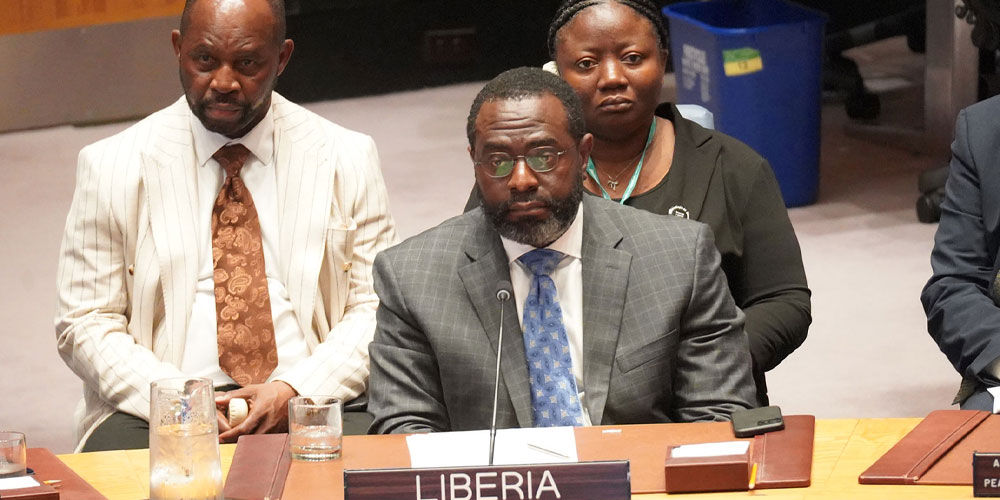
An A3 statement on "Reports of the Secretary-General on the Sudan and South Sudan: Abyei, UNISFA"as delivered by H.E. Baba Sillah, at the 10149th meeting of the UN Security Council held on Thursday, May 7, 2026
Thank you, Mr. President,
- I have the honour to deliver this statement on behalf of the A3 members, namely the Democratic Republic of the Congo, Somalia, and my own country, Liberia.
- We thank ASG Martha Pobee and Special Envoy for the Horn of Africa, Guang Cong, for their briefing, and we take note of the Secretary-General’s report on the situation in Abyei.
- For the A3, Abyei represents a test of whether unresolved political questions in Africa are managed through dialogue or allowed to slide back into violence.
- The A3 remains deeply concerned by the continued lack of progress on the political process regarding the final status of Abyei. The report speaks to a region at a breaking point and reminds us that the people of Abyei continue to pay the price for decisions delayed and commitments unmet. Abyei is a territory that links communities, cultures, and livelihoods. Its instability reverberates beyond its borders, affecting both Sudan and South Sudan.
- The absence of sustained dialogue between Sudan and South Sudan, and the non-functioning of key mechanisms such as the Joint Political and Security Mechanism (JPSM) and the Abyei Joint Oversight Committee (AJOC), continue to impede progress. This deterioration reflects the absence of credible political horizons and the resulting vacuum that armed actors are exploiting. In this regard, we underscore that there is no alternative to a political solution. We call on all parties to re-engage constructively, including through the resumption of dialogue under the auspices of the African Union, with the support of IGAD and the United Nations. African‑led solutions remain central to African peace.
- At the same time, this Council cannot be indifferent. We are alarmed by the deterioration of the security situation in Abyei. The continued presence of unauthorized armed actors in violation of the area’s demilitarized status is unacceptable. We are particularly concerned by reports of intercommunal violence, the proliferation of small arms, and rising criminality that further exacerbate insecurity and place civilians at risk. Abyei was meant to be demilitarized, and that commitment must be respected.
- In this regard, the A3 advances three clear priorities:
- First, Abyei must return to its demilitarized status, and all unauthorized forces must withdraw without delay.
- Second, Sudan and South Sudan must urgently reactivate the AJOC and the JPSM as the only viable channels for preventing escalation and restoring confidence.
- Third, the protection of civilians and United Nations personnel, including full accountability for all attacks on peacekeepers must remain non-negotiable.
- We strongly condemn the drone attack of 13 December against UN personnel, which resulted in the tragic loss of life among the Bangladeshi contingent. We extend our deepest condolences to the families of the victims and to the troop-contributing country. We reiterate that attacks against United Nations peacekeepers may constitute war crimes, and those responsible must be held accountable. Africa knows the cost of protracted conflict and that silence and inaction only deepen instability.
Mr. President,
- In this challenging context, UNISFA remains indispensable. The Mission continues to play a critical role in maintaining stability, protecting civilians, facilitating humanitarian access, and supporting dialogue. However, we note with concern the growing operational constraints facing the Mission, including restrictions on its freedom of movement, logistical challenges, and the impact of resource limitations. These challenges are further compounded by the disruption of the Joint Border Verification and Monitoring Mechanism, which remains a key confidence-building tool between the two countries.
- We stress that UNISFA cannot substitute for political will. Sustainable peace in Abyei ultimately depends on the commitment of Sudan and South Sudan to resolve their differences through dialogue. We also highlight the concerning humanitarian situation, marked by displacement, limited access to basic services, and increased vulnerability of communities. The absence of functioning rule of law institutions, including the Abyei Police Service, further compounds these challenges. In the immediate term, the Abyei Police Service must be established as agreed, supported by the rapid deployment of UN Police at authorized strength.
- The A3 reiterates its concern regarding approaches that seek to link the future of the Mission to benchmarks that are largely outside the control of UNISFA. While progress by the parties is essential, the Mission’s mandate should be guided by the realities on the ground and the need to ensure stability, rather than conditionality that may risk premature adjustments. In this regard, we underscore the importance of maintaining adequate support and resources for UNISFA to effectively implement its mandate.
- The humanitarian situation also demands urgent attention. Displacement is rising, basic services are declining, and funding shortfalls are leaving dangerous gaps. We call on Member States to meet their financial obligations. Peacekeeping and protection cannot be sustained on promises alone.
- In closing, we call on the parties to demonstrate renewed political will, to resume dialogue, and to take concrete steps toward the demilitarization of Abyei. The A3 remains committed to supporting efforts aimed at achieving a just, peaceful, and lasting solution for Abyei. We urge action now, because the cost of delay is counted in lives.
I thank you